
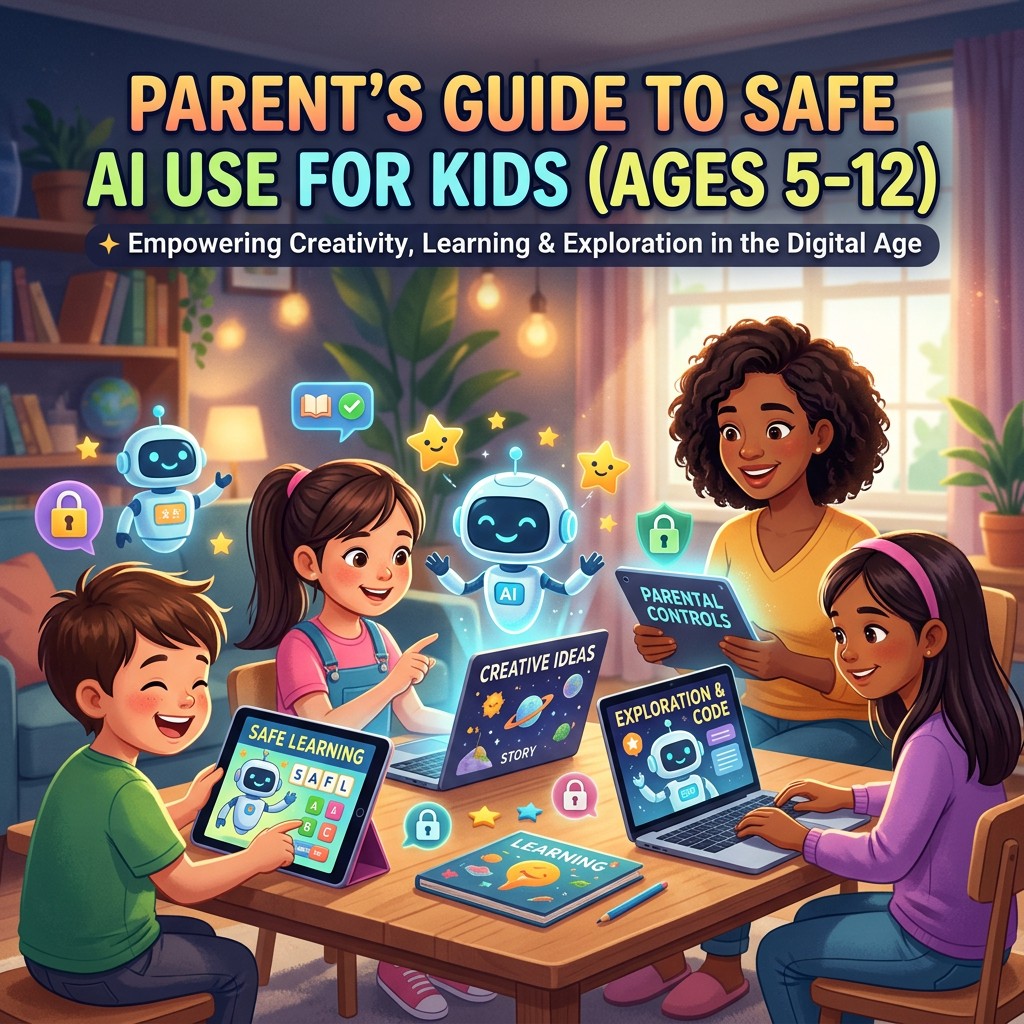
Raising Safe & Smart AI Users: A Parent’s Guide for Ages 5–12
Imagine your family has just moved into a brand-new neighborhood. The boxes are still stacked in the hallway. The streets are unfamiliar. You don’t yet know which houses have friendly neighbors, which corners are safe to play on, or which shortcuts lead somewhere you’d rather your kids not wander.
As a parent, your job becomes clear: help your children explore this new place with confidence, curiosity, and safety.
So you walk the neighborhood with them. You point out the safe routes. You explain which houses they can visit. You warn them about the busy intersections. You teach them how to get home if they feel lost.
You don’t lock them inside forever. But you also don’t let them roam freely on day one.
This is what it means to raise children in the age of artificial intelligence.
AI is the new digital neighborhood, and our kids are already noticing it. The good news: parents don’t have to be tech experts to guide their children through it well. You just need a map, a few clear rules, and a sense of when your child is ready for which streets.
First, Let’s Define What We Mean by “AI”
One of the biggest sources of parental confusion is that “AI” gets used as if it were a single thing. It isn’t. For practical purposes, families encounter two very different kinds:
- Embedded or adaptive AI. This is AI built into educational tools, accessibility features, and recommendation systems — reading apps that adjust to your child’s level, speech-to-text features, math platforms that personalize practice. These tools are generally closed systems with more predictable outputs.
- Conversational or generative AI. This is open-ended technology like ChatGPT, AI companions, image generators, and chatbots that hold human-like conversations or create new content on demand. The output is unpredictable, and the interaction can feel like talking to a person.
This distinction matters enormously. When this guide recommends strict limits for younger children, those limits apply mainly to conversational and generative AI. Adaptive educational tools and accessibility supports — when parent-approved — can be appropriate even for young children.
Welcome to the AI Neighborhood
AI is no longer a futuristic idea. It’s woven into homework tools, games, smart speakers, and creative apps. For American children ages 5–12, AI is becoming a part of the neighborhood just like sidewalks and cul-de-sacs. Though I could not find data use by this age group, it’s likely that many are at least being exposed to AI generations made by others.
According to Common Sense Media’s 2024 report on teens and generative AI, 70% of U.S. teens (13–18) have used at least one generative AI tool, and only about a third of parents whose teens use such tools are aware of it. The UK regulator Ofcom has reported similar patterns among teens, with use among younger children rising but still lower.[¹][²]
In other words, many children — especially in the upper end of our 5–12 range — are already wandering this neighborhood. Some have no map, no rules, and no adult walking beside them.
Why Younger Children Need Guardrails Around Conversational AI
Think of a five-year-old at the edge of a busy street. They might know the words “look both ways,” but they don’t yet have the judgment to time a crossing or react if a driver makes a mistake. They need an adult’s hand — not a lecture.
Conversational AI is similar. UNICEF’s 2021 Policy Guidance on AI for Children warns that children’s cognitive development, limited media literacy, and tendency to anthropomorphize technology make AI systems — especially open-ended ones — uniquely challenging for young users.[³] Pediatric and developmental psychology research supports cautious, age-appropriate introductions to interactive technology.[⁴]
1. Their brains are still building the skills AI demands. Developmental psychology research consistently shows that young children have:
- Limited ability to distinguish fact from fiction
- Underdeveloped critical-thinking and source-evaluation skills
- A strong tendency to anthropomorphize technology — treating responsive devices as if they have feelings or intentions (a pattern documented in research by Sherry Turkle and others)[⁵]
- Difficulty understanding intention or motive
Chatbots feel human. To a young child, talking to AI can feel like talking to a person who lives inside the screen.
2. They can’t easily evaluate accuracy. Generative AI can be confidently wrong. It can state false information — what AI researchers commonly call “hallucinations” — with the same calm certainty it uses for true information. Children under 10 tend to assume: if it sounds smart, it must be true; if it talks like a person, it must be trustworthy. This is developmentally normal — and exactly why open-ended AI is risky at this age.
3. They are vulnerable to emotional attachment. UNICEF’s policy guidance specifically flags the risk that children may form emotional bonds with AI systems that simulate empathy and responsiveness.[³] Young children form attachments quickly, confuse responsiveness with relationship, and struggle to understand boundaries with non-human agents.
Think of how a young child treats a favorite stuffed animal — as a real friend with real feelings. AI chatbots tap into that same instinct, but they talk back.
4. They cannot meaningfully protect their privacy. Children’s privacy advocates, including the Future of Privacy Forum and the Center for Democracy & Technology, have raised concerns about AI systems collecting voice data, chat logs, and behavioral patterns from minors.[⁶] U.S. federal law (COPPA) requires parental consent for data collection from children under 13, but enforcement around newer AI tools is still evolving. Children can’t meaningfully consent to data collection, and parents often don’t realize it’s happening.
5. They are at higher risk of exposure to inappropriate content. Even with filters, generative AI can produce themes, imagery, or advice that is developmentally inappropriate or confusing for young children. Filters are like fences — most of the time they hold, but gaps exist.
Age-Tiered Recommendations
The framework below is the author’s synthesis based on current guidance from UNICEF, the American Academy of Pediatrics’ general digital-media recommendations, and developmental psychology research. It is not an official policy of any single organization, and no major body has yet issued binding age-tiered guidance specifically for generative AI. These recommendations focus on conversational and generative AI, not adaptive educational tools.
Ages 5–7: Avoid conversational or generative AI; allow parent-approved educational tools. This is the “watch from the window” stage. Children this age shouldn’t be interacting with chatbots or generative AI directly. Adaptive reading apps, accessibility tools, and structured educational games are generally fine when you’ve vetted them.
Ages 8–10: Co-use only, for short, specific purposes. This is the “stand on the porch with you” stage. If conversational AI is used at all, it should be:
- Short
- Purpose-specific (e.g., looking up one fact together)
- Always co-used with a parent
- Never used as a friend or emotional confidant
Adaptive educational AI can continue to expand at this age.
Ages 11–12: Begin guided introduction. This is the “walk a few steps ahead, but stay close” stage. AI use can begin to include:
- Short, supervised interactions
- Fact-checking habits (“Let’s verify what it said.”)
- Privacy rules (never share names, schools, addresses, photos)
- Emotional boundaries (AI is a tool, not a friend)
This is the earliest age at which conversational AI becomes developmentally appropriate — and only with strong guardrails.
The Good Streets: Where AI Genuinely Helps Kids
Every neighborhood has places you want your kids to know well. AI is no different.
For younger children (ages 5–10), with parent approval:
- Adaptive learning tools. Research from RAND Corporation and others suggests well-designed personalized learning can support reading and math gains, though evidence is mixed and depends heavily on implementation. Most of this research predates generative AI.[⁷]
- Accessibility supports. Speech-to-text, text-to-speech, predictive text, and visual aids can be transformative for children with dyslexia, ADHD, vision impairments, or speech differences.
- Structured, closed-system educational apps with predictable, age-appropriate content.
For older children (ages 11+), with guidance:
- Guided brainstorming for stories, projects, and ideas
- Creative exploration of art styles or new concepts
- Learning fact-checking habits by comparing AI answers to trusted sources
- Homework support — as an explainer, not a ghostwriter
The Risky Corners: Where Kids Need Protection
Every neighborhood also has places you warn your kids about. With AI, these include:
- Privacy violations
- Inaccurate or misleading information (“hallucinations”)
- Biased outputs
- Inappropriate content
- Emotional dependency on chatbots or AI companions
Red Flags to Watch For
- Over-reliance: “I can’t do my homework without AI.”
- Emotional attachment: “The AI understands me better than people do.”
- Secretive use: hiding apps, conversations, or screen time
- Copy-and-paste homework with no understanding of the content
- Exposure to upsetting content
- Sharing personal details with AI tools
If you notice these, it’s time to walk the neighborhood together again.
Household Rules: Your Family’s Neighborhood Map
A simple framework:
- AI use happens in shared spaces (kitchen table, not bedroom)
- Parents approve all AI tools before use
- No personal information — ever
- Homework must be kid-created (AI explains; the child writes)
- Time limits apply, just like any screen
- Kids can always tell an adult if something feels weird — no punishment for asking
Sample Scripts for Parents
You don’t need a tech vocabulary. Try these:
- “AI is a computer tool. It sounds like a person, but it isn’t one. It doesn’t actually know you, and it doesn’t always tell the truth.”
- “If AI ever says something confusing or makes you feel uncomfortable, come find me. You won’t be in trouble.”
- “AI can help you think, but it can’t think for you. Your brain still does the work.”
- “We don’t tell AI our real name, school, address, or anything private — just like we wouldn’t tell a stranger.”
What If Your Child Is Already Using AI Heavily?
Many parents aren’t starting from zero. If your child is already a heavy user:
- Don’t shame. Reset calmly: “We’re learning about this together, and I want to set some new family rules.”
- Reduce gradually. Move from solo use to co-use. Shorten sessions. Shift conversational AI use to weekends or specific tasks.
- Replace, don’t just remove. Offer alternatives — books, building projects, time with friends, outdoor play.
- Talk about what they like about it. If they say AI “understands them,” that’s worth a conversation about real-world connection.
When School Requires AI Tools
Many schools are now introducing AI for learning. As a parent, you can:
- Ask which specific tools are used and what data they collect
- Ask whether use is supervised and how teachers verify learning
- Ask about opt-out options if you have concerns
- Reinforce at home that AI is a helper, not a homework substitute
A respectful question to a teacher: “Can you tell me which AI tools my child will use this year and what safeguards are in place?”
Homework: Drawing the Line
The clearest household rule is also the most important: AI can help brainstorm or explain, but your child writes the final answer.
If a child uses AI to outline ideas, they should still write the words. If they don’t understand the explanation, they ask a person — a parent, a teacher, or a tutor — not the AI again. The goal is learning, not output.
You’re the Guide
AI is the new neighborhood our children are growing up in. They will explore it — with or without us. But they will be safer, wiser, and more confident if we walk with them long enough to teach them the routes, the shortcuts, and the places to avoid.
You don’t need to be an AI expert. You just need to be what you already are: a parent who protects, guides, and prepares their children for the world they’re stepping into.
The goal isn’t to keep them inside forever. The goal is to help them learn how to navigate it — until one day, they can walk it on their own.
Sources
[1] Common Sense Media. The Dawn of the AI Era? Teens, Parents, and the Adoption of Generative AI at Home and School. September 2024. https://www.commonsensemedia.org/research
[2] Ofcom. Children and Parents: Media Use and Attitudes Report 2024. April 2024. https://www.ofcom.org.uk
[3] UNICEF. Policy Guidance on AI for Children, version 2.0. November 2021. https://www.unicef.org/globalinsight/reports/policy-guidance-ai-children
[4] American Academy of Pediatrics. Family Media Plan and Council on Communications and Media policy statements on children and digital media. https://www.healthychildren.org/MediaUsePlan
[5] Turkle, S. Alone Together: Why We Expect More from Technology and Less from Each Other. Basic Books, 2011 (and subsequent research on children’s responses to social robots and conversational agents).
[6] Future of Privacy Forum and Center for Democracy & Technology. Reports on student data privacy and AI in education. https://fpf.org and https://cdt.org
[7] Pane, J. F., et al. Informing Progress: Insights on Personalized Learning Implementation and Effects. RAND Corporation, 2017. (Note: most rigorous research on adaptive learning predates current generative AI tools.)
Note: Research on children and generative AI specifically is still emerging. Recommendations in this article reflect the author’s synthesis of current expert guidance and developmental psychology research, and may evolve as longer-term studies become available. No major medical or child-welfare organization has yet issued binding age-tiered guidelines specifically for generative AI use by children.